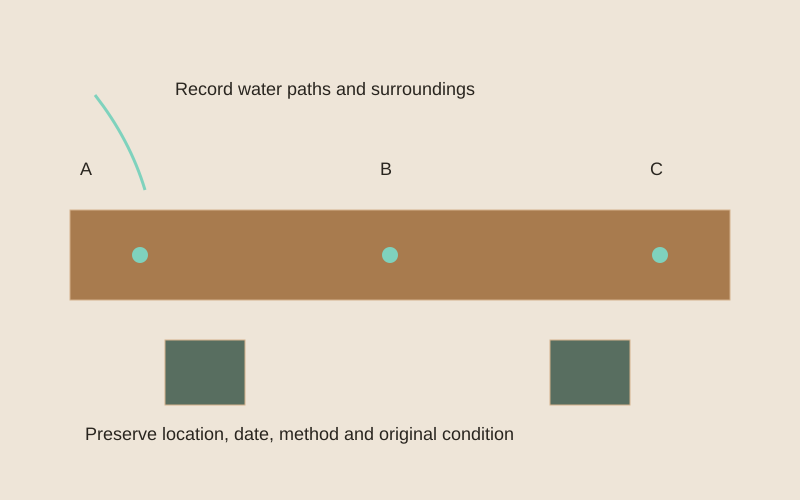
- Locate observations on the component before discussing causes or repairs.
- Record nearby supports, water paths and the timing of changes.
- Sample locations shown are conceptual, not a required sampling plan or instructions to access unsafe areas.
Define the question
State whether the concern is a recent leak, persistent wetting, dimensional change, a finish problem, or unexplained deterioration. Draw a location map and identify accessible surfaces. A focused question determines which comparisons are useful. Avoid collecting many unlabeled readings that cannot later be connected to a board, face, event, or proposed explanation.
Document the measurement method
Record meter type, instrument instructions, species setting or correction, temperature considerations, and measuring position. Note coatings, metal proximity, and access limitations. Follow the instrument's guidance rather than assuming every display is directly comparable. USDA's drying chapter covers moisture measurement; its principles support a careful method, not a universal acceptance value for every hardwood application.
Use comparison locations
Select affected locations and suitable reference locations within the investigation area. Keep the choice visible on the map and explain why the locations are being compared. Record individual readings with date, recent weather, and surface condition. A reference area is a comparison, not proof that its entire concealed assembly is dry or free of deterioration.
Trace possible wetting and drying conditions
Observe runoff, splash, nearby irrigation, covered areas, debris, and accessible drainage paths. Record what actually happens during relevant conditions when this can be observed safely. Separate a visible water path from a proposed hidden route. Do not conclude that the highest reading identifies the source without considering measurement method, timing, and surrounding materials.
Repeat with a purpose
If repeat monitoring is appropriate, use the same mapped locations and method after a relevant change or event. Preserve raw records and describe any change in conditions. Ask the responsible reviewer which result would justify opening an assembly or changing a detail. Repeated numbers are useful when they test a question; they are less useful when collected without a decision plan.
Practical checklist
- State the investigation question before measuring.
- Record meter settings and location identifiers.
- Compare affected and reference locations consistently.
- Tie repeat visits to an event or decision.
Worked example
Hypothetical example: readings are higher near an irrigated border after watering. The investigator repeats mapped measurements under documented conditions and examines the water path, rather than declaring one reading proves a hidden leak or a manufacturing defect.
Limits of this guide
A moisture meter does not certify structural soundness or identify every concealed wet area. No universal percentage threshold is given here. Species, instrument, temperature, geometry, and the assessment purpose influence interpretation.
Continue the decision
Map board shape instead of calling every distortion warp
Investigate surface staining without assuming decay or corrosion
Separate finish appearance from the underlying condition
Start an investigation