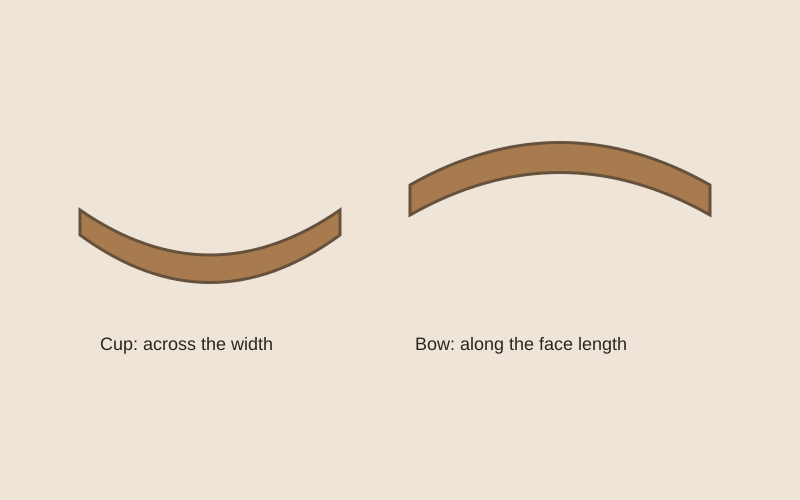
- Cup curves across the board width.
- Bow curves along its face length.
- Exaggerated geometry explains vocabulary; it does not grade severity or establish a cause.
Choose a direction and reference
Describe whether the visible deviation occurs across the width, along the face length, along an edge, or as a twist between ends. Cupping commonly describes curvature across width; bowing describes lengthwise face curvature. Include an annotated sketch so the reader does not have to infer the direction from terminology alone or from an oblique photograph.
Record the assembled condition
Photograph the board in place and note support locations, adjacent boards, fasteners, and accessible underside conditions. State whether it is installed or loose when measured. A piece constrained by connections is not the same observation as that piece after removal. Preserve the before-removal condition if removal is part of a reviewed investigation.
Measure reproducibly
Identify the reference tool, its placement, the board location, and the point of the recorded offset. Retain individual readings rather than reporting only the largest number without context. Avoid forcing the board flat during measurement. If the surface is textured or worn, explain how the reference was positioned so later comparisons do not mistake a different measuring method for physical change.
Look for patterns
Map whether the condition appears near edges, wet areas, covered zones, or specific installation lots. USDA describes wood movement in relation to moisture and grain direction. Use that principle to organize questions about exposure and material history, not to declare that one observed curve proves a particular moisture source or installation error.
Connect the finding to a decision
Identify the practical concern: appearance, trip potential, joint fit, attachment distress, or an unresolved structural issue. Ask the appropriate reviewer what observations are needed to choose monitoring, correction, or replacement. Do not jump from a geometric label to a repair method. A replacement can repeat the same problem if the relevant surrounding condition remains unidentified.
Practical checklist
- Show the direction of deviation on a sketch.
- State whether the board was installed or loose.
- Record tool placement and measurement locations.
- Map distribution before proposing a cause.
Worked example
Hypothetical example: several boards look uneven in a photograph. A location survey separates cross-width curvature from a lengthwise rise over one support, giving the assessor two distinct observations instead of one broad complaint that the deck is warped.
Limits of this guide
Shape terminology is descriptive, not a diagnosis. This guide gives no allowable curvature or safe-use threshold. Capacity, trip risk, and repair details require evaluation of the actual assembly and its intended function.
Continue the decision
Build a moisture investigation around locations and repeat readings
Create an evidence record that survives the repair
Document a loose connection before reaching for a driver
Start an investigation