Text equivalent
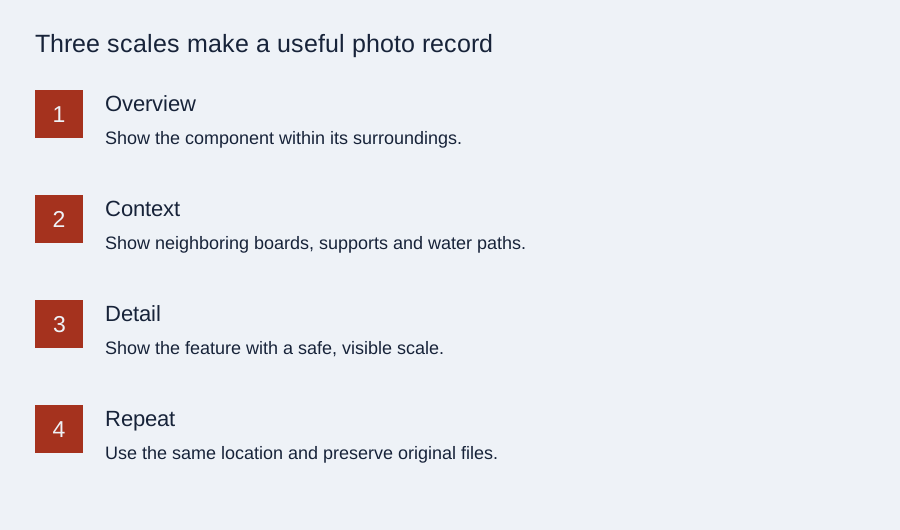
Overview
Show the component within its surroundings.
Context
Show neighboring boards, supports and water paths.
Detail
Show the feature with a safe, visible scale.
Repeat
Use the same location and preserve original files.
Photograph only from a safe position. A scale beside the surface cannot reveal hidden depth, condition or load capacity.
Download diagram (SVG)Original educational diagram · Hardwood Failures · September 14, 2026.
Build a repeatable photo sequence
A close-up is useful only when someone can locate it. Take an overview, a context view and a detail from safe positions, and give the photographs a shared location reference. You do not need a large collection of nearly identical close-ups.
Overview: locate the component
Show the affected area within the project. Record which elevation, bay, board or other identifiable location the photograph covers. Include enough surrounding features to find the same position again. Avoid relying on filenames alone if several similar areas exist.
Context: retain the nearby conditions
Show the neighboring components and visible interfaces relevant to the observation. Note whether the surface was wet or dry and whether cleaning or other work had already occurred. A context view can preserve those conditions without claiming which one caused the feature.
Detail: show the feature without hiding its limits
Use a visible scale where it can be placed safely, and keep its units legible. A scale in a different plane from the feature can be misleading. If no reliable scale was available, record that instead of presenting a photograph-derived dimension as a measurement.
A detail image cannot establish concealed depth, connection capacity or the condition behind a surface. Preserve that boundary in the caption. Good focus and lighting improve the record; they do not make hidden information visible.
Repeat: make comparison possible
Use the same location and a comparable viewing direction for follow-up photographs. Retain the date, surface condition and any work performed between visits. A changed camera angle, wet surface or different light can alter the apparent feature, so record those differences when they cannot be avoided.
Keep the original files. Use copies for arrows, labels and cropping, and identify those as annotated versions. Do not overwrite the only original with an edited image.
A compact fictional record
For location B7, name the files B7-overview, B7-context and B7-detail with the visit date. Add: “surface dry; before cleaning; detail scale in millimeters; no depth measurement.” A later set should retain B7 and state what changed between visits. The captions communicate evidence limits as well as location.
Attach the photo references to an investigation record. Read the documentation guide for the accompanying product and project information.