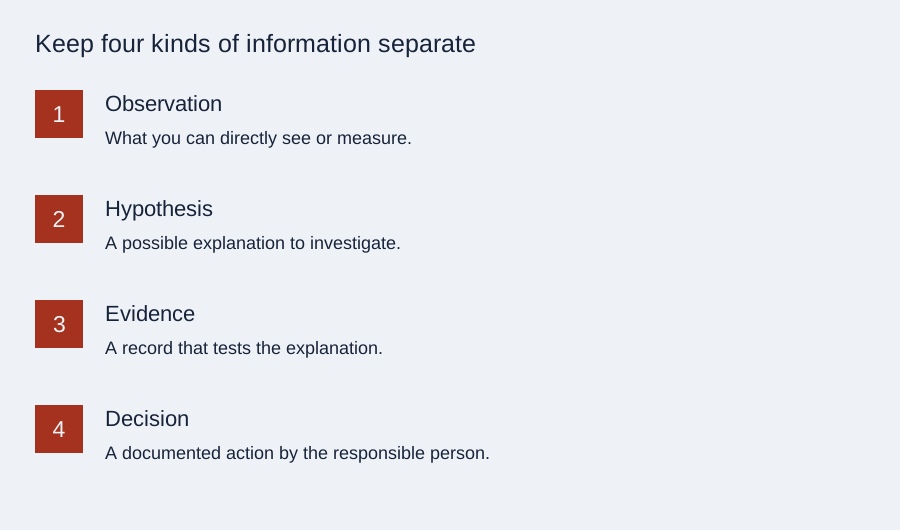
Text equivalent
Observation
What you can directly see or measure.
Hypothesis
A possible explanation to investigate.
Evidence
A record that tests the explanation.
Decision
A documented action by the responsible person.
Example: staining near a fastener is an observation. Corrosion is one possible explanation; appearance alone does not verify it.
Download diagram (SVG)Original educational diagram · Hardwood Failures · September 14, 2026.
Use the four-part record
A useful investigation starts with a description another person could check. Keep the visible condition separate from the explanation you suspect. This lets later evidence change the explanation without erasing the original observation.
Write the observation without assigning a cause
For a fictional example, write “dark mark around the exposed fastener at board B7” rather than “wrong screws caused corrosion.” Add the location, date, whether the surface was wet or dry, and a photograph reference. The first statement describes a feature; the second combines an unverified material claim with a cause.
If you measured something, record the method and units. If you only estimated it from a photograph, say so. “First noticed today” is not the same as “began today.” Keep an unknown start date unknown.
Give each hypothesis a question
Do not make a list of possible causes look like a diagnosis. For each proposed explanation, state what information would help evaluate it. In the staining example, the supplied fastener identity and relevant product records may be questions for review. A photograph of a dark mark does not establish an alloy or hidden condition.
Evidence may support, contradict or fail to answer the question. Retain that result explicitly. A missing invoice is missing evidence, not confirmation that the wrong material was installed.
Record the decision separately
Name the responsible person, the action and the evidence available when the decision was made. A decision to obtain records is different from a decision to repair. If the cause remains unresolved, keep that limitation with the action rather than upgrading the hypothesis to a fact.
For the fictional board B7 record, a reasonable documentation outcome is “retain photographs, request the material identifiers and refer the condition for review.” This example does not select a treatment or decide whether the assembly is safe.
Keep a change history
When new information arrives, add it with its date and source. Do not silently rewrite the original observation to fit the final explanation. The sequence helps a reviewer distinguish what was known initially from what was learned later.
Use the investigation record to organize observations and open questions. For broader documentation practice, see the documentation guide.