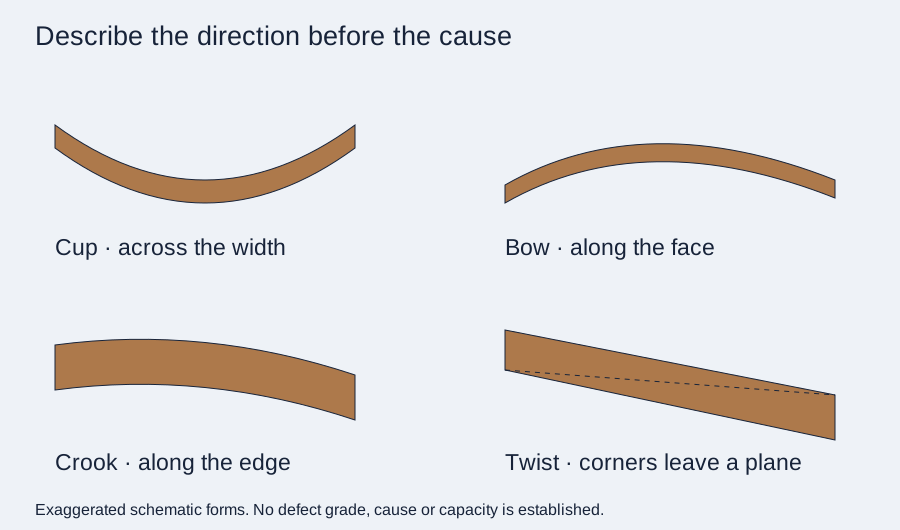
Text equivalent
Cup
Curvature across a board’s width.
Bow
Curvature along the face length.
Crook
Curvature along an edge.
Twist
Corners depart from one plane.
Describe direction and location before discussing cause. These vocabulary distinctions do not grade a board or establish safe use.
Download diagram (SVG)Original educational diagram · Hardwood Failures · September 14, 2026.
Describe the board before its cause
Cup, bow, crook and twist describe directions of distortion. They are a vocabulary for recording shape, not a diagnosis, grade decision or permission to keep a component in service.
Give the reader a viewpoint
Identify the board’s face, edge, ends and installed location before using a shape term. A photograph taken at an angle can make direction difficult to interpret. Pair a view along the board with an overall view so the reviewer knows which dimension the description concerns.
Use cup for curvature across the width, bow for curvature along the face length, and crook for curvature along an edge. For twist, describe how the corners depart from a common plane. More than one condition can be present; do not force a mixed shape into a single category.
Separate the board from the reference
State what the apparent deviation is being compared with: a neighboring board, a visible support line or a documented measurement reference. An uneven neighboring surface is not automatically a reliable datum. If no measurement was made, use “appears curved” and retain the view rather than assigning a number from the image.
For any recorded measurement, retain the board location, span being observed, units, method and date. A number without its reference cannot be compared reliably with a later record. Do not apply an invented acceptance limit to the result.
Example: an imprecise description becomes useful
“The boards are warped” leaves the reviewer without a location or direction. In a fictional record, “board C4 appears curved along its exposed edge near the west end; no straightness measurement taken” identifies an observation and its limitation. It still does not explain the cause.
Do not force a shape to test it
Keep documentation within safe access and observation. Do not loosen connections, load an uncertain assembly or force a board flat simply to obtain a clearer photograph. A concern about a loose or unsafe component needs appropriate assessment beyond this vocabulary guide.
The cupping and bowing guide expands the distinctions. The investigation tool lets you retain the condition and questions without assigning a cause.